












Efficiency Bottleneck in DDR5 Multi-Corner Timing Verification: PDA Analysis Methods
-
 2026.05.27
In DDR5 design, every change to ODT settings, routing topologies, or data rates triggers a fresh round of multi-corner simulations to ensure timing margins remain intact. PDA (Peak Distortion Analysis) offers a more efficient alternative: instead of running full sequences, it calculates the worst-case distortion upper bound—the "floor" of the valid data window—in just minutes.
I. Iterative Efficiency in Timing Budget Verification
During system-level verification, every parameter tweak—such as shifting data rates, adjusting ODT impedance, or changing routing—requires a complete multi-corner timing simulation.
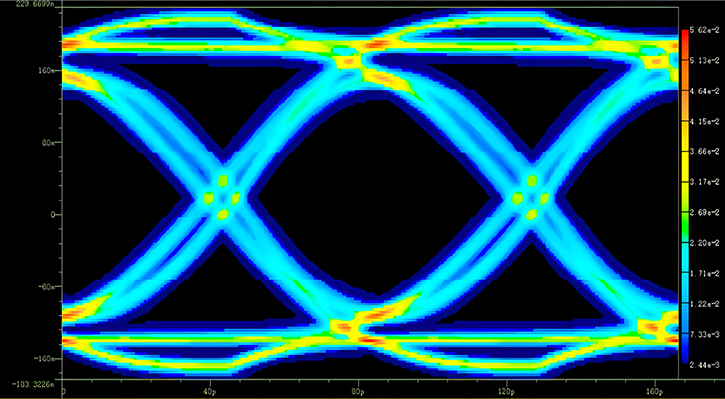
The Logic: Timing budget simulation involves checking eye diagrams and timing margins across various voltage, temperature, and process (PVT) corners.
The Problem: The goal is to ensure the Valid Data Window satisfies specifications even under worst-case corners. While manageable during early design, this becomes a major bottleneck during rapid iteration cycles, where design teams must wait hours to confirm if a change is moving in the right direction.
The PDA Solution: Peak Distortion Analysis shifts the focus from exhausting every corner to finding the upper limit of distortion in worst-case scenarios.
II. The Time Cost of Full Simulation
Traditional PRBS (Pseudo-Random Binary Sequence) simulations consume time primarily due to two factors:
Corner Combinations: Modern DDR5/DDR6 timing verification requires covering multi-dimensional combinations of voltage, temperature, and process corners, with each corner simulated independently.
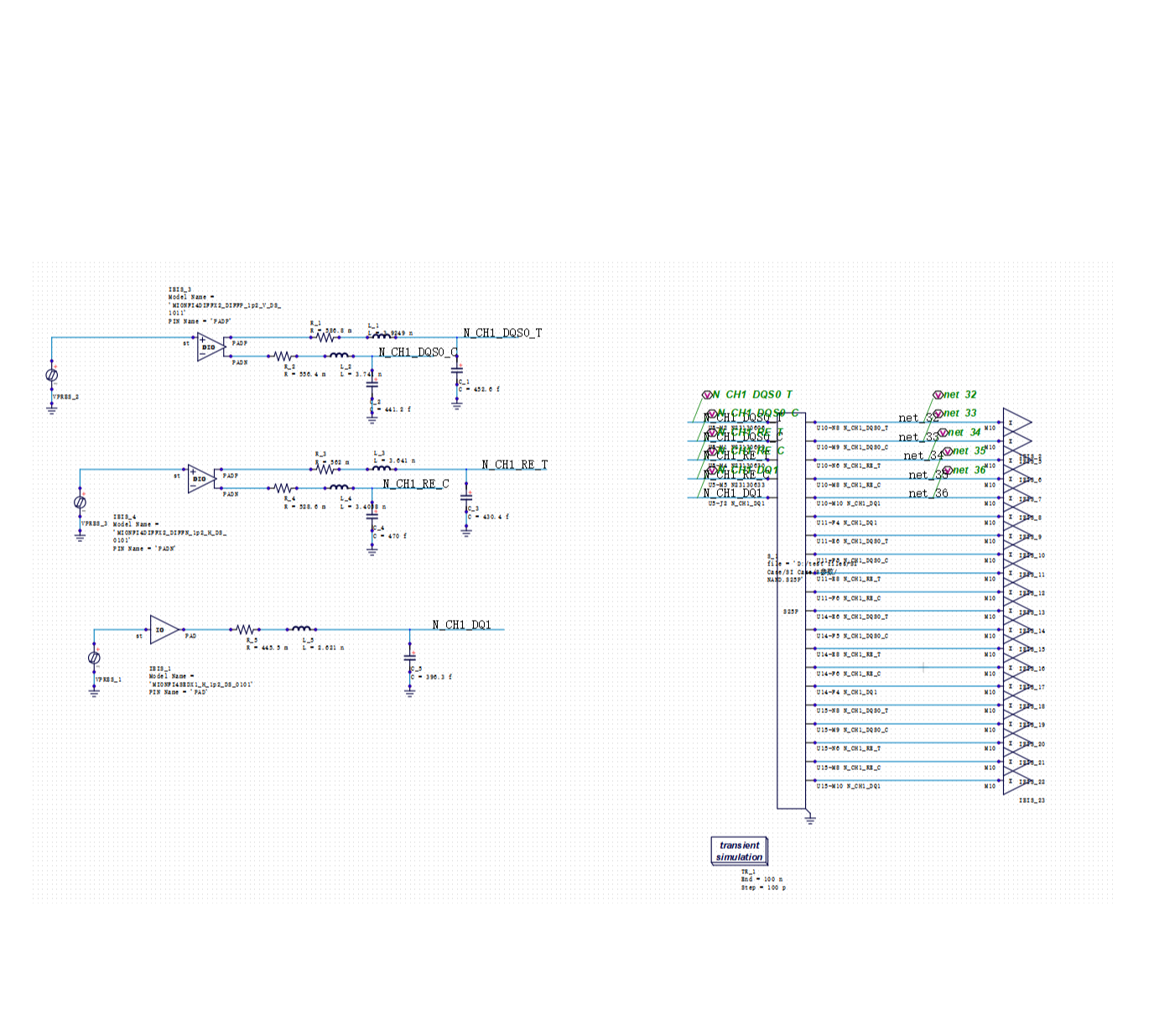
Channel Dependencies: In multi-channel systems, each link possesses unique channel characteristics that cannot be reused, and crosstalk analysis requires parallel processing of multiple paths.
These factors mean single-iteration cycles often take hours, turning the wait time between parameter adjustments and verification into a significant friction point in the design schedule.
III. PDA: Analytic Calculation vs. Exhaustive Simulation
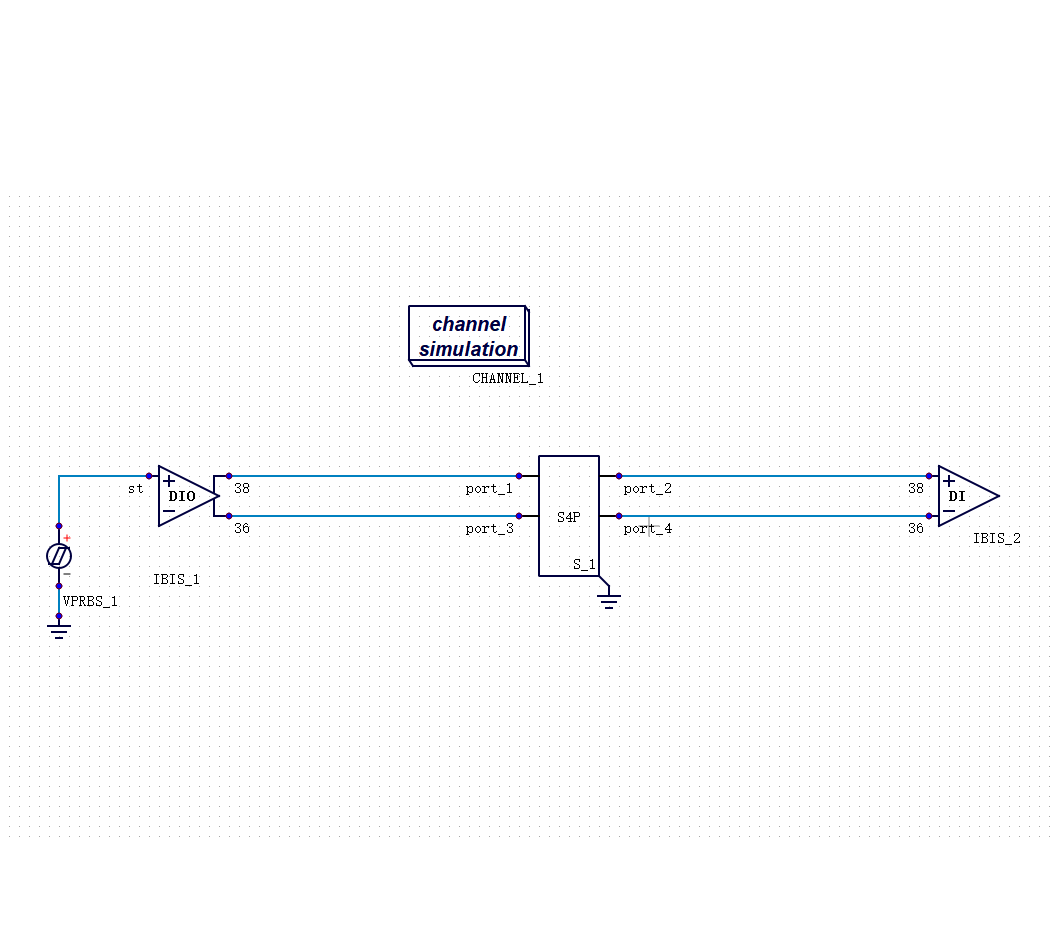
The core concept of PDA is to analyze channel physical characteristics to mathematically deduce which bit patterns cause maximum distortion.
Pulse Response: Every transmitted symbol generates "tails" (ISI - Inter-Symbol Interference) that influence subsequent symbols. PDA analyzes these tails to identify the pattern combination resulting in maximum cumulative interference—the theoretical worst-case pattern.

Peak Distortion Calculation: PDA calculates two types of peak distortion upper limits:
ISI Peak Distortion: Interference accumulated from history symbols in the same channel. Longer tails make ISI harder to control.
Crosstalk Peak Distortion: Accumulated interference from adjacent channels, a critical factor in high-density systems.
Implementation: By combining these, PDA provides the Peak Distortion upper limit for the entire channel. If this worst-case scenario passes, there is no need to run the full, time-consuming simulation sequences. PDA can also output the worst-case pattern for targeted transient verification.
IV. Applications in DDR5/DDR6 Timing Budgets
PDA is a high-value tool for managing the impact of channels on timing margins.
Efficiency: For early-stage design iterations, PDA typically provides conclusions within minutes, enabling dozens of design checks per day compared to the single-digit checks allowed by full-corner scanning.
Quantified Margins: PDA provides a quantitative basis for avoiding over-design, ensuring engineers do not waste area or power for unnecessary 1ps safety margins.
Theoretical Guarantee: PDA provides a deterministic upper bound; if PDA fails, a full simulation is guaranteed to fail. If PDA passes, the ISI and crosstalk timing impact is confirmed.
Scope: PDA covers ISI and crosstalk. Factors like SSO (Simultaneous Switching Noise), power noise, and clock jitter are not covered by PDA and still require full system analysis.
The same principle applies to SerDes channel compliance pre-verification.
The same principle of PDA also applies to high-speed serial link scenarios—before running a full compliance simulation, use PDA to quickly filter out obviously non-compliant solutions, shortening the overall verification cycle.
V. Recommended Use Cases
PDA is most effective in the following scenarios:
DDR5/DDR6 Timing Budgets: Quickly quantifying the impact of ISI and crosstalk on the valid data window.
Rapid Design Iterations: When parameters change frequently, requiring quick confirmation of feasibility.
Multi-Channel Crosstalk Assessment: System-level evaluation for high-density DDR or SerDes channels.
SerDes Compliance Pre-verification: Filtering out non-compliant designs before running full, extensive compliance simulations.

Conclusion:
The bottleneck for high-speed interface iteration is often simulation time, not just accuracy.
PDA serves as a fast screening tool for design iterations, allowing engineers to replace wait times with data-driven decision-making.
If your project involves DDR5/DDR6 timing budgets or high-speed serial link verification, contact us to schedule a demo of SIDesigner to see PDA in action.


Recommended
-
 The Two Structural Barriers in Power Electronics Simulation: Model Portability and Signoff Accuracy
 2026.07.02
 -
 Optimizing DDR Signal Integrity: Using DFQ Sensitivity Analysis (S1/ST) to Identify High-Leverage Design Variables
2026.06.10
Optimizing DDR Signal Integrity: Using DFQ Sensitivity Analysis (S1/ST) to Identify High-Leverage Design Variables
2026.06.10 -
 Efficiency Bottleneck in DDR5 Multi-Corner Timing Verification: PDA Analysis Methods
2026.05.27
Efficiency Bottleneck in DDR5 Multi-Corner Timing Verification: PDA Analysis Methods
2026.05.27 -
 The Mass Production Yield Trap After DDR5 SI Sign-off: Using DFQ to Predict Defect Rates Early
2026.05.07
The Mass Production Yield Trap After DDR5 SI Sign-off: Using DFQ to Predict Defect Rates Early
2026.05.07