












Path to Breakthrough for Domestic SI Simulation Tools
-
 2025.12.08
On November 20, 2025, the 2025 Integrated Circuit Development Forum (Chengdu-Chongqing) and the 31st Integrated Circuit Design Exhibition (ICCAD-Expo 2025) officially commenced in Chengdu. At the "EDA and IC Design Services" thematic forum, Junyong Deng, Vice General Manager of Julin Technology, delivered a speech titled Junyong Deng"Path to Breakthrough for Domestic SI Simulation Tools"Junyong Deng.

EDA, positioned at the very upstream of the integrated circuit industry chain, serves as both the "cornerstone" of chip design and the "lever" driving its innovation. According to report data, the global EDA tool market reached USD 16.73 billion in 2023 and is projected to grow to USD 32.09 billion by 2029, with a Compound Annual Growth Rate (CAGR) of 11.52% from 2024 to 2029 [Source: Mordor Intelligence, "EDA Tools Market Size & Share Analysis - Growth Trends & Forecasts (2024-2029)"]. For the domestic market, China's EDA market size was approximately RMB 13.59 billion in 2024, with a CAGR of 6.55% over the past five years. Analysts forecast that China's EDA market will reach RMB 14.95 billion in 2025 [Source: Ruiguan Consulting, "2025-2029 China Electronic Design Automation (EDA) Software Industry Development Forecast and Investment Analysis Report"].

This growth trend is driven by both market forces and policy support: U.S. restrictions on advanced EDA tools have compelled domestic chip companies to seek local alternatives to ensure supply chain security. Concurrently, national policies such as the "14th Five-Year Plan for Digital Economy Development" have identified EDA as a key area for technological breakthroughs. Special subsidies and tax incentives have effectively reduced the R&D costs and risks for enterprises.
However, the urgent market demand and strong policy pull have not yet rapidly translated into overall competitiveness for domestic EDA tools, especially for simulation tools which have the highest technical barriers. In critical simulation fields like Signal Integrity (SI), domestic tools still face core challenges such as low tool maturity, accuracy not meeting sign-off standards, insufficient market recognition, and weak customer stickiness. A systematic breakthrough is urgently needed at the technical, ecosystem, and conceptual levels.
Precision Breakthrough: Technical Leap to Meet Sign-off Standards
Accuracy is the entry ticket for SI simulation tools to participate in the chip design flow. In the current development stage of domestic tools, accuracy remains the primary obstacle limiting their widespread adoption in actual designs. This manifests in gaps in absolute accuracy compared to international benchmarks, difficulty in ensuring consistency of accuracy, and insufficient stability for long-term operation. These issues directly prevent domestic tools from entering the final sign-off stage of chip design.
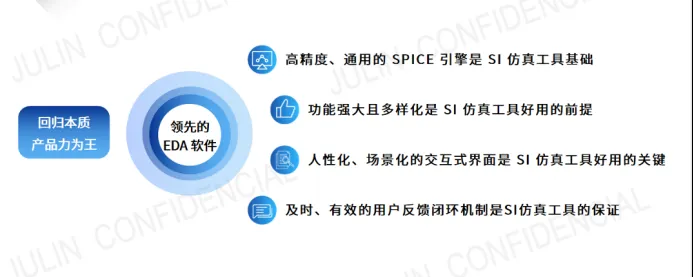
For domestic tools to achieve a breakthrough in accuracy, fundamental innovation in underlying algorithms and simulation engines is essential. Taking the SPICE engine as an example, the stability of its numerical algorithms, the accuracy of device models, and the precision of electromagnetic field solvers all directly determine the reliability of simulation results.
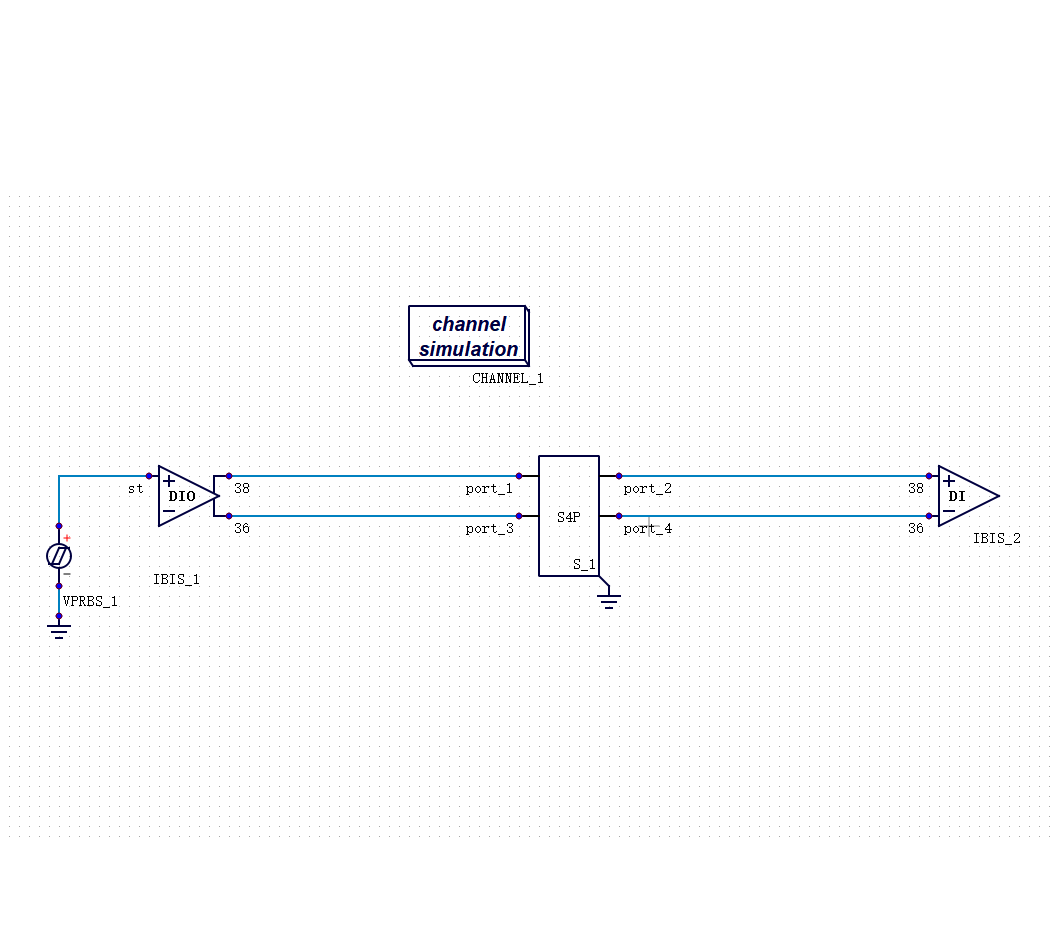
Powered by its Golden-level accuracy True-SPICE simulation core, Julin has built the industry-leading unified SI/PI simulation platform, SIDesigner. It is dedicated to ensuring signal and power integrity at the source of high-speed, high-density designs. The diagram below shows a comparison between the library simulation results of this engine on a basic circuit from a specific Foundry and the actual measured data:
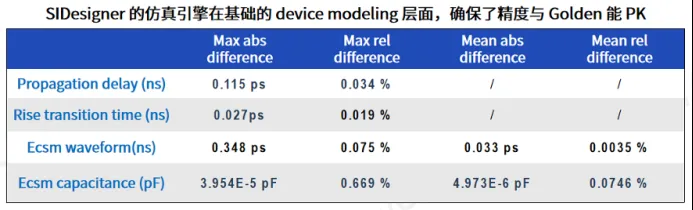
Through standard model support, high-precision parameter extraction, and stable numerical algorithms, SIDesigner achieves highly consistent (error <1%, meeting industry sign-off requirements) transistor-level simulation results with international mainstream sign-off tools across scenarios such as DC, transient, and process corners. This builds the credibility and usability of the tool within the chip sign-off flow.
Scenario Tempering: From "Usable" to "User-Friendly"
Tool maturity is inseparable from tempering in real-world scenarios. A prominent issue facing current domestic SI tools is "procurement without deep adoption"—while some companies purchase domestic tools, they still rely on foreign tools for their core design flows. Behind this phenomenon lies the insufficiency of domestic tools in scenario support, functional completeness, and stability. To break this deadlock, domestic EDA companies must move beyond the comfort zone of non-market-driven procurement and establish deep collaborative partnerships with leading chip design companies.
Over three years, Julin Technology and a leading communications company validated and refined SIDesigner through tens of thousands of real cases. The collaboration evolved from initial testing in partial scenarios to finally achieving a full-scenario switch, establishing a high level of trust in Julin's tool accuracy.
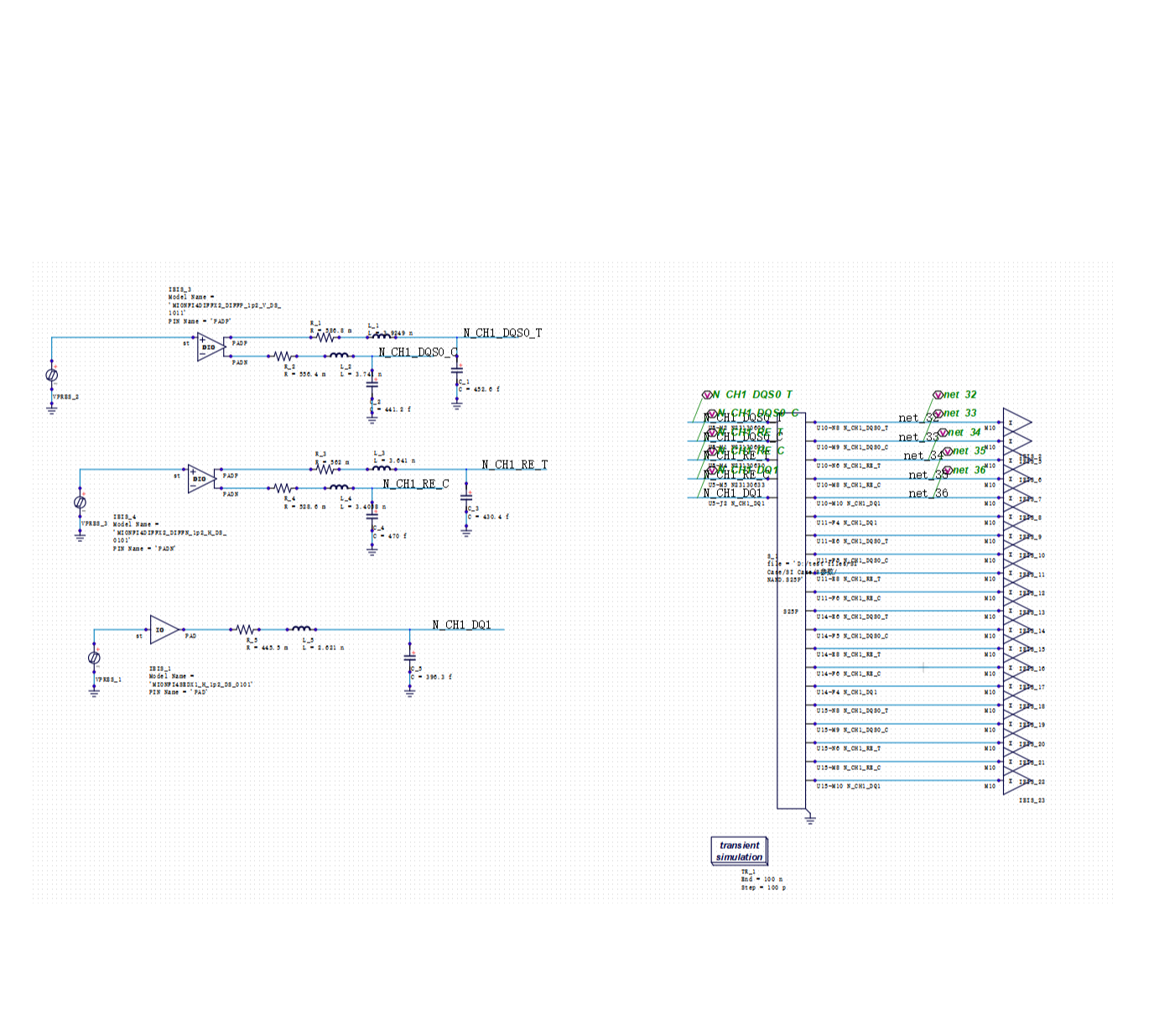
In the memory chip sector, a leading memory company faced flexibility limitations with their previously used foreign tool due to the complex topologies of high-speed interfaces and numerous what-if analyses in their products. After switching to SIDesigner, its flexible topology link construction methods significantly improved workflow efficiency. More importantly, in several instances of result discrepancies during tool comparisons, the domestic tool's results were ultimately proven to be more accurate.
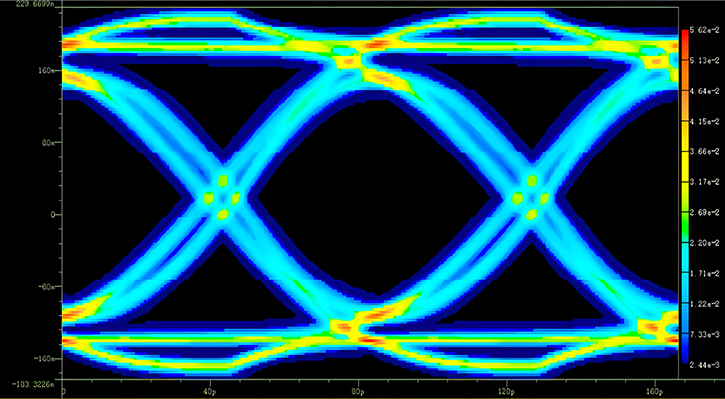
In emerging fields like AI chips, a top AI chip company utilized SIDesigner's DOE (Design of Experiments) capabilities and statistical eye diagram analysis to address accuracy issues with traditional tools in complex scenarios during server-level DDR5 design.
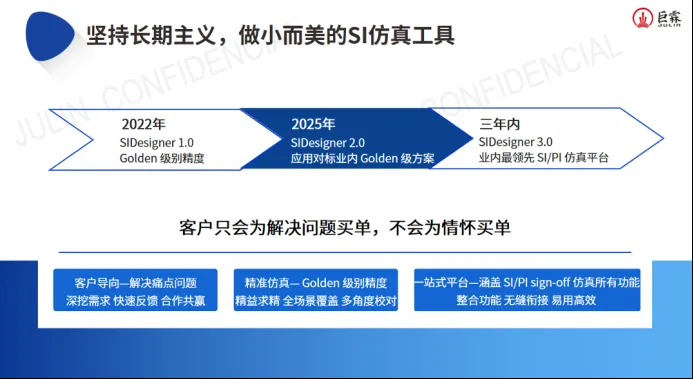
These success cases demonstrate that only by deeply engaging with specific application scenarios and solving actual design challenges can domestic tools truly make the leap from "usable" to "user-friendly."
The path to breakthrough for domestic SI simulation tools is a systematic endeavor requiring technological depth, ecosystem co-construction, and long-term persistence. On this journey, continuous breakthroughs in core technology by enterprises, collaborative cooperation from all industry stakeholders, and respect for the development laws of the entire industry are all essential.
By achieving accuracy breakthroughs to win technical trust, accumulating scenario experience through real applications, and integrating into the industrial system via ecosystem collaboration, domestic tools are destined to cultivate their own towering trees in this fertile land of innovation.


Recommended
-
 AEIF 2026: Julin Tech’s Beijie Qian on Why "Simulation Pass" Does Not Equal "Mass Production Yield"
 2026.05.22
 -
 IIC Shanghai | High-Speed Interface SI Signoff: Precision Limitations of Statistical Domain Algorithms and Path Reconstruction
2026.04.02
IIC Shanghai | High-Speed Interface SI Signoff: Precision Limitations of Statistical Domain Algorithms and Path Reconstruction
2026.04.02 -
 Julin Technology Showcases Unified CPS SI/PI Simulation Platform at ICCAD
2025.12.02
Julin Technology Showcases Unified CPS SI/PI Simulation Platform at ICCAD
2025.12.02 -
 Jiaxin Sun , Founder of Julin: Empowering High-Fidelity System Design with SIDesigner, a Golden-Level Precision SI/PI Sign-off Platform
2025.12.02
Jiaxin Sun , Founder of Julin: Empowering High-Fidelity System Design with SIDesigner, a Golden-Level Precision SI/PI Sign-off Platform
2025.12.02