












DFQ Gets a New Look - Comprehensively Enhancing User Experience
-
 2025.07.08
I. The Role of DFQ in Signal Integrity (SI)
In a previous article, "DFQ: Making Design Even Better," we introduced the Design for Quality (DFQ) plugin embedded within SIDesigner, Julin Technology’s high-speed signal simulation platform. Based on a graphical interactive interface, DFQ provides users with:
Efficient Design of Experiments (DOE)
Parallel Simulation via local or cluster technology
Predictive Modeling through advanced data fitting
Powerful Data Post-Processing and Analysis
As a scientific statistical tool, DFQ allows engineers to understand how multiple variables impact output results under limited resource conditions. By identifying key factors and their relationships, it establishes a mathematical bridge between Responses (outputs) and Factors (input variables). This enables designers to find the optimal combination of factors to reach preset targets with the most economical resource investment.
SI issues, particularly in high-speed signals, involve a myriad of factors:
Physical Parameters: Geometry, material properties.
Electrical Parameters: Driver strength, termination, loading.
Environmental Conditions: Temperature, voltage fluctuations.
These parameters exhibit complex interactions. Optimization usually requires a sophisticated trade-off between multiple objectives. DFQ provides scientific decision support, facilitating visualized cross-department communication. For example, in DDR SI performance design, DFQ analyzes variables such as impedance, process corners, drive strength, crosstalk, and line length. It quantifies the sensitivity of each variable, giving designers a clear, mathematical concept of how changes impact overall performance.
Key Concept: A "Good Design" does not always equal a "Good Product." One must consider manufacturing processes and yield.
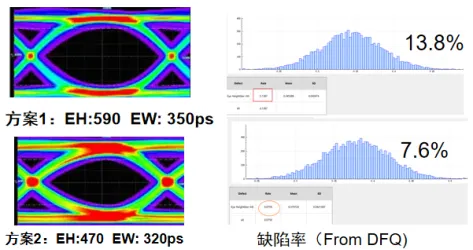
By using the fitted models of various influence factors as a starting point and the error distribution of these factors in actual production as model inputs, Monte Carlo analysis can predict the Defect Rate (UPM). Introducing the defect rate as a decision criterion allows for a more holistic evaluation. For instance, while an SI engineer might prefer a high-performance "Scheme 1," the product manager might choose "Scheme 2" due to its superior manufacturing yield.
II. A Brand New Face for DFQ
The fully optimized DFQ tool is now driven by a Wizard-based interface, significantly improving simplicity and usability. The core functions are conveniently located on the left sidebar, allowing users to navigate the entire DFQ workflow step-by-step:
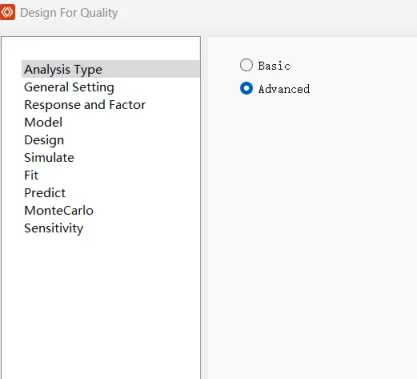
Analysis Type → General Settings → Response & Factor → Model → Design → Simulate → Fit → Predict → Monte Carlo → Sensitivity Analysis.
Enhanced Analysis Modes
Basic Mode: Designed for quick, standard workflows.
Advanced Mode: Supports advanced DFQ processes, including the external import of pre-edited factor tables and the ability to set certain factors as "Fixed" to reduce the complexity of variable factor counts.
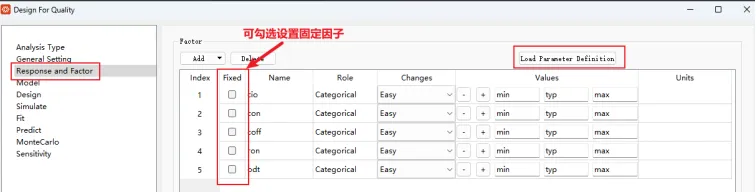
Optimized Design Workflow
In the Design step, all functional buttons are displayed directly on the interface for easy access. The tool now supports the automatic merging of Parameter Factor Tables and DOE Tables, eliminating the need for manual data handling and reducing human error.
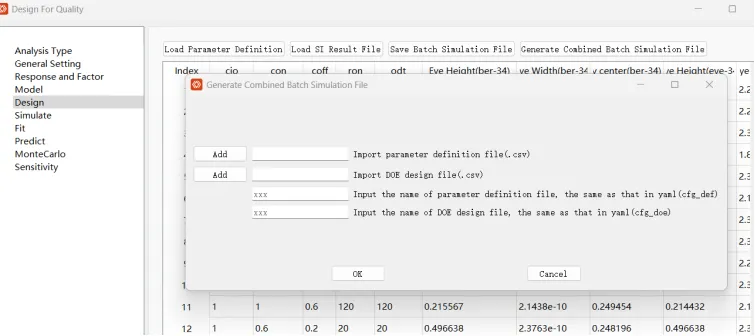
Modular Processing
Fitting, Prediction, Monte Carlo, and Sensitivity Analysis are decomposed into distinct sub-interfaces. This modular approach allows users to select specific processing units based on their current needs without navigating through unnecessary menus.
III. Summary
The DFQ tool by Julin Technology, seamlessly integrated into the SIDesigner SI simulation platform, has undergone a comprehensive upgrade. With its streamlined interface and enhanced usability, it empowers customers to:
Make scientific decisions for product design optimization.
Enhance cross-departmental collaboration through visual data.
Achieve the optimal balance between high-performance design and manufacturing yield.


Recommended
-
 The Two Structural Barriers in Power Electronics Simulation: Model Portability and Signoff Accuracy
 2026.07.02
 -
 Optimizing DDR Signal Integrity: Using DFQ Sensitivity Analysis (S1/ST) to Identify High-Leverage Design Variables
2026.06.10
Optimizing DDR Signal Integrity: Using DFQ Sensitivity Analysis (S1/ST) to Identify High-Leverage Design Variables
2026.06.10 -
 Efficiency Bottleneck in DDR5 Multi-Corner Timing Verification: PDA Analysis Methods
2026.05.27
Efficiency Bottleneck in DDR5 Multi-Corner Timing Verification: PDA Analysis Methods
2026.05.27 -
 The Mass Production Yield Trap After DDR5 SI Sign-off: Using DFQ to Predict Defect Rates Early
2026.05.07
The Mass Production Yield Trap After DDR5 SI Sign-off: Using DFQ to Predict Defect Rates Early
2026.05.07